
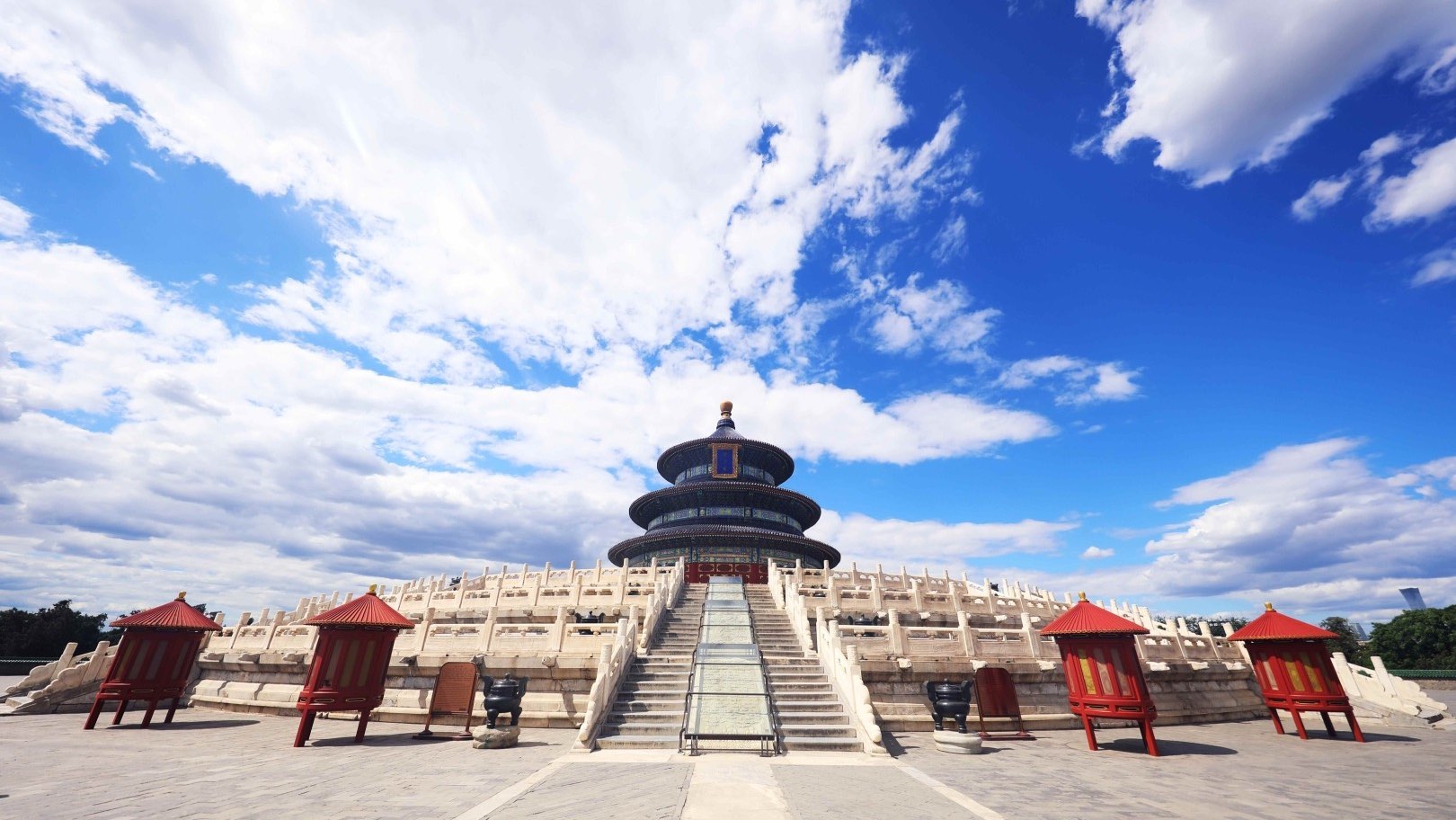
Built in 1420 (the 18th year of the Ming-dynasty Yongle Emperor’s reign), the hall is about 38 meters tall with a diameter (as measured between the outer eave columns) of about 24 meters. Originally called the “Great Sacrificial Hall” and rectangular in shape, it was used to worship Heaven and Earth. In 1545 (the 24th year of the Ming-dynasty Jiajing Emperor’s reign), it was rebuilt as a triple-eave circular structure with a gilded conical roof and glazed tiles in azure, yellow, and green from top to bottom, and it was named the “Great Offering Hall.” In 1751 (the 16th year of the Qing-dynasty Qianlong Emperor’s reign), all the tiles were replaced with blue ones, and it was given its present name. It came to be used exclusively for the ceremonies of praying for good harvests that took place in the first lunar month.